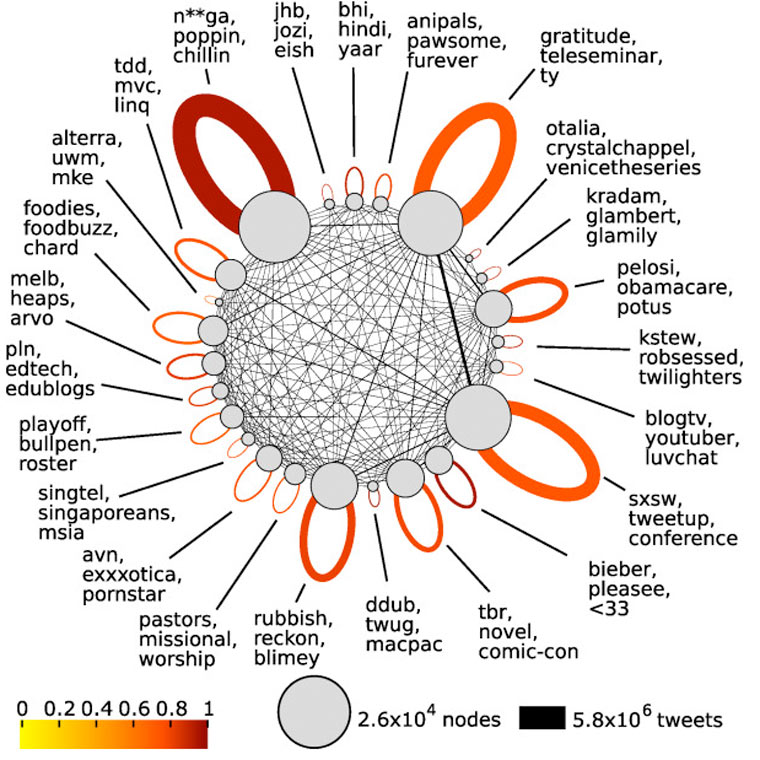
 Don’t know how convinced I am by this…they include terribly idiosyncratic terms like ‘rubbish’ and ‘Bieber’ ; ) But there are some interesting tidbits, not least the assumption that these tweeters are communities, and also some really emergent cultural grammars as well.

TwiTribes
Comments Off

Church of Fools

Steph’s post on papal intrigue made me think (in a rhizomic way, of course) about this site, a virtual church. This seems to highlight the porous relationships among the physical, mental, spiritual and emotional, and between humans and digital creations, especially as traditional physical religious spaces are meant to point (in some way) to something non-tangible…
On another tangent, this is linked to the Ship of Fools site, which perhaps suggests the pastoral idea of the church as community more than a pixeled nave…although perhaps loses something in the architecture of a discussion board?
Comments Off

The Talking Shoe
Pair this with some Google Goggles and an iWatch and you’ve got the latest spring cyborg! (But do they get along?)
Comments Off
This Article Generating Thousands Of Dollars In Ad Revenue Simply By Mentioning New iPad
This seemed appropriate for a discussion of where a person ends and technology begins–fits quite well with Pickering’s temporal emergence. And it adds a new dimension to speech act theory 
Also, if it had been real, what would my reposting do…?

I would rather be a cyborg than a goddess
These are my notes and reflections about the Haraway chapter, in no particular order or rationalisation…
For the first few pages I felt like I was reading James Joyce (and much amused by a later reference to the same). I’m not sure if the style changed or I just got used to it, but I think it also had something to do with my pretty much complete lack of knowledge about feminist theory/history/tropes. I didn’t feel like I was a member of the community Haraway was addressing (online or off!).
Maybe this is why one of the points under ‘State’ struck me: ‘invisibility of different social groups to each other’ (p.50). I felt that the ‘book audience’ was a social group that was invisible to me; not that I would not be interested in the same things they were, or that I might disagree with them politically or socially, but that I didn’t have the assets that I would have needed to be a member. And I think this is closely related to Haraway’s problematisation of ‘unity’. As identity is neither one-dimensional nor static, uniting a group based on a single, unchanging identifier is (at least) unsatisfactory. Her mention of affinity groups (p.38), then, struck a chord as far as our conversations over the last couple weeks about what defines community and whether and how much identity is involved… Obviously I didn’t have the right ‘affinities’.
But Haraway seems to struggle with this a bit, which is perhaps why I noticed it more. For example, from my uninitiated perspective, I felt that ‘developing feminist science/technology politics in alliance with anti-military science facility conversion action groups’ or the ‘welding’ of ‘personal preferences and cultural tendencies’ onto politics (for middle-class professionals) (p. 49) was unification on the assumption that ‘if you have affinity A, then you’ll probably have affinities B and C’). This didn’t seem to fit in with the heterogeneous cyborg at all. There’s a high likelihood that I’m missing the point, but I’m concerned that it might be more difficult to sustain messy plurality than Haraway sometimes intimates. Haraway certainly doesn’t try to hide her potential subjectivism, but it is interesting to see it creep in unexpectedly, as when she generalises from specifically American issues.
I found the insistence on questioning the existence of an objective ‘organic or natural standpoint’ (p.39) especially applicable to conversations around online/offline duality. I was wondering if this relates to survival. Several times Haraway makes it clear that the aim of the cyborg is survival (p. 49, 53, 54) but I’m not sure if this is meant to be the aim so much as the explanation of a process of natural selection by which the people who are the best at being cyborgs are more likely to survive…? Or if it’s meant to be conscious survival, it does seem to suggest a curious Machiavellianism. Or is it the survival of an evolving kind of cyborg feminism? Or something else?
week 8 summary
I’ve been struck by a few things this week in finalising my ethnography and [reading? viewing? interacting with?] other people’s.
First, I think most of us got a bit hung up on the definition of ‘community’ and whether the things we were studying were communities or not. I imagine that this was part of the learning, and so was no bad thing. Certainly I’ve got a broader concept of community now, and I think this will help with, e.g. concerns over whether students are properly ‘socialised’ before beginning to interact online…
This led to another interesting trope–that social connections can be ‘mediated’ by shared interests. Chantelle showed this well, for example: Person A (with interest in X) <--> Blog B about X <--> Person C (with interest in X). Even if neither comment, I think the idea that the blog has a large readership in itself affects how A and C will feel about reading a blog about something they have a personal stake in. This is stretching it a bit, but likewise if A commented, I think it would be the degree of C’s interest in X (and thus how often she looked at the blog, read the comments, etc.) rather than her desire to comment herself that would give her the sense of belonging.
I think this is also linked to the fluidity of online communities; i.e., just because A is only interested in X for a year, or a month, or three days, it doesn’t necessarily make her less of a community member…
Comments Off
The Professors’ Big Stage
The first few paragraphs are especially of interest, suggesting the superstar academic. Is this a real cultural phenomenon or is it a bit more complicated…?
Comments Off
#durbbu mini ethnography
Here is my mini ethnography on the twitter feed for the Durham Blackboard Users Conference 2013. I decided to use Storify as I was intrigued by the approbation of narrative style in ethnographies both in Hine (2000, p. 44) and in a chance email quoting Carolyn Ellis (The Ethnographic I, 2004) regarding autoethnography. Not to mention that it seemed to handle tweets well within a ‘story’ context!
One of the reasons that I chose this community was that it ticked all the boxes for an ethical analysis:
1) What ethical expectations are established by the venue?
Twitter is considered to be a very public forum. I have first determined that each tweet I quote was available without logging into twitter (e.g. via twubs or a search engine) before posting it.
2) Who are the subjects posters / authors / creators of the material and/or inter/actions under study?
All contributors were adults attending a professional event.
3) What are the initial ethical expectations/assumptions of the authors/subjects being studied?
Participants were not told that the twitter feed was private, nor were they cajoled into using it. Participants could set their own twitter preferences, or refrain from tweeting all together. Participants may not have been aware that the tweets at this hashtag were being aggregated on another site (twubs); this aggregation had been applied to the hashtag by a third party for at least two years before the event in question. However, for the purposes of this ethnography I only used tweets which appeared both in this public space and publicly on twitter.
4) What ethically significant risks does the research entail for the subject(s)?
The possible harm here is minimal. It is possible that a participant who did not understand how twitter works could have posted tweets that they did not wish to be public. However, this study does not significantly add to this risk, as the tweets were already public.
week 7 summary
I’ve been thinking a lot about transience, as this has arisen as an unexpected theme in my ethnography. Does a community have to be sustained to be a community? For how long?
This is closely related to the question of whether people who come together to do something (exchanging information, getting someone elected, joining a flash mob, etc.) are a community, or just a bunch of people. The quote that Gina picked out of Bell, ‘compatible consumption’, suggests that we can take this view, and so Harlem Shake participants could be a community; people voting for the release of an Audrey Hepburn film could be a community; 1980s banking computer operators could be a community…
And conference attendees can be a community. Which leads to my main issue with transience this week, namely the disappearance of tweets from a hashtag search. This led me to think about other instances of online community artefact transience, and what this means to the community members. I will explore this as far as twitter is concerned in my ethnography, but it’s important to note that it isn’t unique to twitter.
Finally, I’ve been thinking about ways to produce my ethnography, and am quite taken with the idea of ethnography as subjective narrative (particularly as I was a participant, and unaware that I was going to be scrutinising the community later!).
Comments Off
Amazon rainforest tribe at centre of new cultural storm
Here’s an anthropologist who seems to want to relegate post-modernism to ‘comparative literature, gender studies, philosophy and others’. But don’t worry–proper science will eventually reclaim the field!
Comments Off

Recent Comments