This was certainly true for me and I love(d) books. So I’m wondering, what made this so exciting?

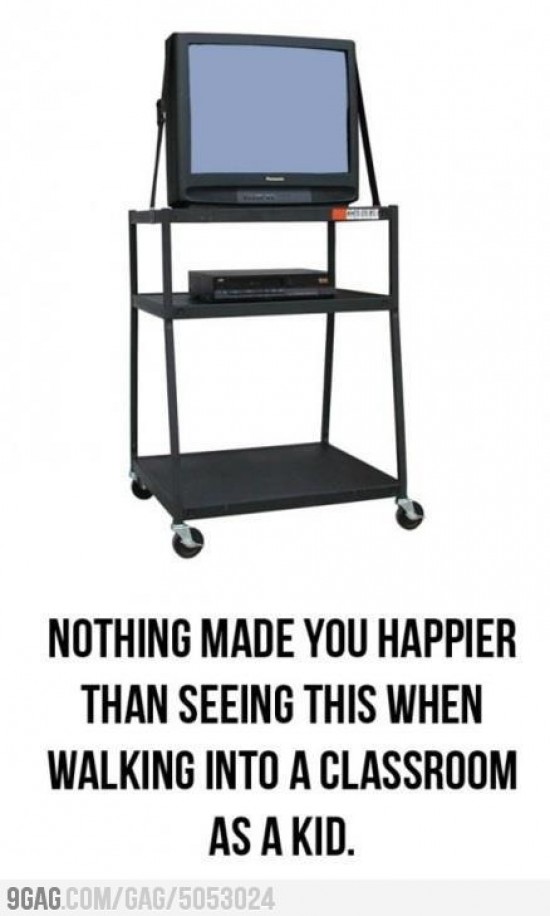
This was certainly true for me and I love(d) books. So I’m wondering, what made this so exciting?
© 2016 Steph's E-learning and Digital Cultures site. All Rights Reserved.
Powered by WordPress. Designed by 
My school-aged self couldn’t agree more! I’ve sometimes wondered if it was novelty or laziness (except when the teacher had you take notes) that made the wheeling in of the TV such an event. But with this theme of literacies, I’m wondering if it was partly to do with the idea that something audio-visual was by its nature fun–I suppose because most experiences of TV and movies would have been as entertainment, not education. So perhaps we were just blindsided by education masquerading as fun : )
But this is chicken-and-egg really–perhaps audio-visuals are so favoured by the entertainment industry precisely because they really are fun for the human mind–able to present images and stimulate the brain with more diverse experiences than text has to offer…?
When I think back to the use of Media in the classroom I remember most the element of mystery attached to the black screen portal – a gateway to anything/anywhere!
Textbooks were what we viewed as the ‘norm’ of teaching/learning tools so anything outside of this was exciting. Perhaps I’m being slightly nostalgic here [and the post text might begin to wobble slightly with flashback effects] but the TV always seemed to roll out in our classroom on Friday afternoons – the weekend began early!
I think you raise a very interesting point about the chicken and the egg, and I wonder how that phenomenon is developing with emerging technologies. I wonder, for instance, if audio-visuals now have to also be interactive to really hook audiences…?
What I remember most about the TV in the classroom was the various countdown clock channel idents that were displayed before the schools programmes started. We used to pretend to shoot the disappearing minute markers, the aim being to shoot them at precisely the correct time. Perhaps we were early interactive gamers!
http://625.uk.com/tv_logos/flash/itv_schools_clock_79.asp
http://625.uk.com/tv_logos/flash/bbc_schools_clock_82.asp
my schooldays were back in the 70s, and the only class where AV was used was in art history, it left an amazing impression on me that to this day I am still pursuing.
Our books were handed down generation after generation and there was no such thing as updating the materials. Most books had some photos, but usually in black and white, colour printing was far too expensive …. (and the books being in dutch, there is a higher cost, due to lower circulation) .
It is amazing to think that we did’t actually look for info, just relying on the compulsory books and the occasional library visit. (which I was quite used to back then)…
It certainly makes a stark contrast with teaching and learning practices nowadays, a utopian outcome of the visuality constraints of a bygone era.